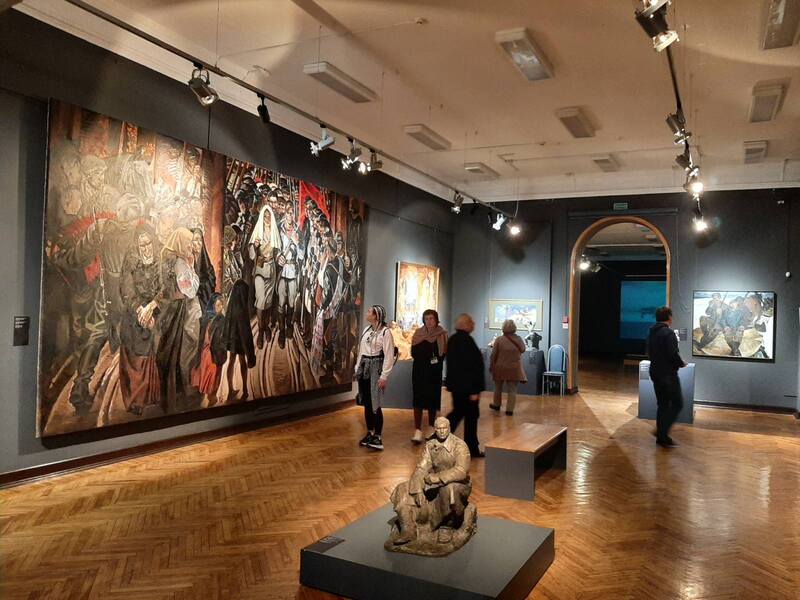
The exhibitions vary in concept and presentation, yet all are united by a common theme: the 80th Anniversary of the Great Victory. One, however, stands out in particular. The exhibition «The next day, the whole earth» offers visitors a unique encounter — with paintings that come to life before their very eyes.
Initially showcased at the Palace of the Republic as part of the «Every Third» project, this exhibition always drew large crowds. Guests could witness a fusion of classic Belarusian war-themed painting and remarkable modern technology. Through augmented reality, the canvases quite literally come alive, drawing the viewer into the emotional whirlwind of past events.
Twelve paintings from the collection of the Belarusian State Museum of the History of the Great Patriotic War are on display, including works by Mikhail Savitsky, Yevgeny Tikhonovich, Isaac Davidovich, Ivan Tikhonov, Yevgeny Zaytsev, Anatoly Shibnev, and others. The animated video content accompanying the artworks was created by students of the Belarusian State Academy of Arts. «Here’s how it works: after scanning a QR code and pointing your phone camera at a painting, the image begins to animate,» explains project curator Gennady Kurilovich. «This year, the project was expanded. We began working with the National Art Museum. And now there’s a new feature: while students still produce the animation content, artificial intelligence has also been incorporated. As a result, each work is given a logical continuation. For instance, scenes about the heroes of the Brest Fortress are now supplemented with archival photographs of the actual defenders.»


According to Gennady Kurilenko, all the featured artists were participants in the Great Patriotic War. «This allows us to witness those events through the authentic eyes of the artists who lived them,» he notes. Visitors can also learn more about the artists’ biographies during the exhibition.
After its run at the Palace of the Republic, the exhibition moved to the Presidential Library and then to the House of Representatives of the National Assembly. There, it was viewed not only by deputies, but also by representatives of delegations visiting the parliament.
An equally remarkable exhibition commemorating the 80th anniversary of Victory is on display at the National Art Museum. Titled «The Artist at War. The Artist on War. The Artist after War», the show features painting, graphic art, sculpture, and decorative applied arts from the 20th and 21st centuries. All the works are drawn from the museum’s own collection — a visual chronicle of wartime and post-war Belarus. At the center of the project is the figure of the artist, whose personal vision and narrative about the Great Patriotic War and Victory intertwine with the impressions of eyewitnesses, memories of those who were children during the war, and interpretations by those who know the war only through stories.
At the exhibition’s opening, Anna Kononova, Director General of the National Art Museum, emphasized that this year is dedicated to a sacred milestone for the Belarusian people — the anniversary of the Great Victory. «Every event this year is inspired by this great celebration,» she said. «Art about war and Victory bears witness to the indomitable spirit of the Belarusian people. The works of our artists, many of whom fought on the front lines, embody the genetic and cultural code of our nation.»
Kononova also warned of a troubling global trend — the erasure of culture and the substitution of truth with falsehoods. This, she said, poses a serious risk of losing the memory of our victory and the generation that secured it. «At this exhibition, one can not only see but truly feel the reverence, strength, and power in the works of Belarusian artists. They will not leave your soul untouched. This revelation will reach every heart,» she added.
Natalya Sharangovich, Deputy Chairperson of the Belarusian Union of Artists, called the exhibition a rare opportunity to discover unfamiliar works by beloved artists. She reminded visitors that the Union was founded in 1938, just a few years before the war began. At one point, the Union attempted to count how many of its members had gone to war, combing through veterans’ personal files. The result was staggering: 155 artists. «Most of our members put down their brushes and paints and went to the front,» Sharangovich noted.


The war, heroism, and pain were central themes for every member of the Union, especially in the postwar years. Many artists entered the profession as children of war. «Once you become familiar with their work,» Sharangovich concluded. «You will understand why wartime and postwar generations devoted so much attention to this theme. You will see the true gene of life, of struggle, of victory and resistance — the resistance of the Belarusian people.»
Yes, the wartime era is a vast world of emotions and experiences, shaped by its own social, psychological, and moral characteristics. Each generation of artists has sought its own key to unlock this world.
Art of the 1940s and 1950s — widely regarded as the starting point for the development of the military theme — is often criticized for its idealized portrayal and excessive theatricality. However, when viewing these works, it is important to remember that what might now seem like «varnishing» was, in fact, an expression of sincere emotions. These pieces simultaneously served as documents of their era, personal experiences of the artists, and reflections of a collective spiritual uplift. They can only be fully understood within this unified context.
The artistic method of the «grand style» itself led to a kind of visual literariness and dramatization of war events. It required numerous preparatory studies and sketches, reflecting the Belarusian school of socialist realism’s commitment to faithfully representing nature. Art of that time was a direct response to events still fresh in living memory. This gave rise to the emotional intensity, authenticity, and narrative depth that defined the dramatic structure of these works.

The leading artists of the first post-war generation consistently found compelling visual solutions for their paintings, which is why their works have stood the test of time. Monumental, multi-figure compositions by Yevgeny Zaytsev, Sergey Romanov, Ivan Akhremchik, and Valentin Volkov, as well as sculptural portraits by Zair Azgur and Andrey Bembel, have become classics. Frontline sketches and studies also played a crucial role in shaping military-patriotic themes in visual art, capturing everyday moments of war with poignant immediacy.
Even then, key motifs and storylines were already taking shape — heroic death, confrontation, grief and loss, the chaos of battle, wartime suffering and occupation, and archetypal portraits. Among them, the partisan epic occupied a central place, revealing a wide range of human and moral dimensions of war. This epic significantly influenced the evolution of Belarusian visual art.
As time passed, a shift in the artistic perspective on war became evident, as seen in the works exhibited at the National Art Museum. New motifs and emphases began to emerge. The focus moved away from documentary accuracy toward uncovering the deeper philosophical meanings of events, their timeless resonance, and a more publicistic, reflective tone. Without a doubt, this new direction enriched and expanded the horizons of visual art, with the military-patriotic theme playing a key role. Artists such as Leonid Shchemelev, Georgy Poplavsky, Viktor Gromyko, Nikolai Nazarchuk, Nikolai Nazarenko, and Boris Arakcheyev explored this path with success. Moral themes, previously rare in their work, became dominant—canvases began to depict the drama of human fate, of farewells and separations.
Works like «Partisan Wedding» by Mai Dantsig, «Birth» by Leonid Shchemelev, and various pieces by Mikhail Savitsky offered innovative approaches to the theme. Ordinary events were transformed through metaphors and symbols, their meanings intensified by expressive silhouettes, plasticity, and color.
Yet soon, interest in the documentary essence of the past was rekindled. By the 1970s, many artists sought to revisit and truthfully relive that past, as seen in the large-scale compositions of Ivan Tikhonov, Anatoly Shibnev, and Sergey Romanov. During this period, Mikhail Savitsky created his unique series «Numbers on the Heart», based on autobiographical material. These paintings are not just a dramatic account of wartime trials, but an intense monologue from a participant and witness to horrifying events. His interpretation of the war stands out for its deep emotional resonance.
Over time, for many artists — including veterans — the emotional spectrum associated with war became the central element of their creative expression. The theme of «women and war» emerged, ranging from depictions of refugees, widows, and desolate landscapes to symbolic, generalized images. On the painting «June 22: Brest Fortress» by Iosif Belanovich, the mourning figure of a mother with a child evokes the classical theme of remembrance. This topic was treated with lyrical gentleness in Fyodor Baranovsky’s famous painting «The Bathhouse», where a joyful, everyday scene celebrating female beauty creates a powerful contrast to the grim reality of war.
Symbolic compositions became increasingly common, where the war was depicted indirectly — through people, nature, architecture, or objects. Examples include Boris Nepomniachtchy’s wartime still life «I Walked Through That War», and «Portrait of a Son» by Nikolai Kuichik.
The war, as both a social and cultural phenomenon, does not require an overtly grandiloquent artistic language. It has always been, and remains, closely tied to eternal questions of good and evil, joy and sorrow, life and death, loyalty and betrayal — in other words, the very foundation of artistic creation in any style, genre, or medium.

For older generations of artists, war was part of their personal biographies. Many of their works took the form of epic narratives, often based on real-life events. But the further we move from the time of war, the more artists turn to interpretative approaches — psychological, romantic, or lyrical. War began to acquire a «human face». New artists were not only reflecting on actual events or heroic acts; they searched for emotional depth, for associations, for joy and longing — expressed while standing at the easel. The opportunity to convey hidden, intimate thoughts and feelings seemed to come naturally.
It is fair to say that in the 21st century, the military-patriotic genre has continued to evolve. The main difference lies in perspective: while earlier artists spoke of war in the first person, relying on their own memories, today’s artists «read» the theme associatively — reframing it through history, courage in the face of the enemy, or the collective joy of Victory.
Nikolai Opiok, head of the Studio of Military Artists under the Ministry of Defense, puts it this way: «Our task is not to lose what our predecessors achieved.» Today, these studio artists seek to understand the realities of modern military service. After visiting military facilities, they create numerous sketches and studies that become the basis for works on army life. Among them are «Graduates of the Minsk Suvorov School» by Nikolai Opiok, «Buinichi Field» by Vladimir Urodnich, and «Ballad of the Pilot Vladimir Korvat» by Vladimir Gordeyenko.
For more than eighty years, peaceful skies have stretched over Belarus. Their blue is reflected not only in the eyes of children but in the country’s painting. Peace and humanism are among the national traits of Belarusians, and Belarusian art continues to celebrate them through the efforts of its true creators. The war theme has naturally become one of the central pillars of Belarusian visual art and played a decisive role in shaping the national art school. The works featured in the exhibition are imbued with strong emotional depth. Each painting conveys, in its own way, the bitter, brutal truth of the most terrible war of the 20th century.
Each generation of artists has brought its own worldview to the theme, shaped by time and fate. What unites them is an understanding that such a theme demands truth — free of artificial effects or forced pathos. For the mid-generation artists, interest in the theme stemmed not only from its scale but from a desire to reflect on dramatic historical events, to try their hand at a socially meaningful subject filled with grandeur, psychology, and tragedy. In the second half of the 20th century, the military theme became a supreme benchmark of artistic mastery in Belarus, as historical and mythological genres had once been for 19th-century painters.
War left its mark on the lives of many Belarusian artists. Yet to their credit, they did not allow the memory of heroism and suffering to fade — they preserved those intense feelings in their art.
Without exaggeration, the art exhibitions dedicated to the 80th anniversary of Victory in the Great Patriotic War have become among the most significant cultural events this May. After all, the alliance of war and the artist is a complex one — easily derailed from the path of truth. Depicting the reality of a process so contrary to human nature, the artist must remain true to their creative self. At the same time, war must not be reduced to a set of sanitized postcards. It is a difficult task.
And perhaps the most profound phenomenon is not just the triumph over evil, but the fact that the victors emerged from war with their humanity intact. This too is telling of art. In Belarus, where the people deeply experienced the horrors of war, art found a new momentum. The post-war years became its golden age — a time when the national art school was truly formed.
Certainly, the theme of war occupied a prominent place in Belarusian artistic creation. Yet the interpretations varied widely — from the dramatic canvases of Mikhail Savitsky to the cheery still lifes and landscapes of Leonid Shchemelev. This breadth of vision has always characterized Belarusian art, as demonstrated once again by the recent exhibition at the Palace of Arts hosted by the Union of Artists of Belarus. Although mostly traditional in nature, the exhibition powerfully conveyed the strength of the human spirit and the heroism of the soldier in a just war of liberation.
In May, two floors of the Minsk Palace of Arts were dedicated to artworks reflecting the theme of war. The works of artists, imbued with the full power of individual emotion, revealed the essence of the severe trials endured by people during the wartime era. Naturally, the exhibition included paintings by those who had personally experienced the war. This fully applies to the People’s Artists of Belarus, Leonid Shchemelev and Viktor Gromyko. They had lived through the war themselves and possessed the life experience necessary to convey its terrifying reality.
Such people are often said to have «endured». We are speaking about a generation that faced an exceptionally harsh trial — the war. Viktor Gromyko, for example, not only endured the hardships of that brutal time, but also took part in the liberation of his homeland from fascist occupiers. In 1941, he became a member of an underground resistance group in the city of Orsha. He later served as a scout, a machine gunner, and even a commissar in a special-purpose regiment. He edited the newspaper People’s Avengers. Behind these dry facts of military biography lies tremendous effort, courage, and human dignity. The war also revealed Viktor Gromyko’s boundless love for life, which found expression in his rich and diverse creative work. His artistic legacy is inextricably linked to high ideals about the meaning of life, spiritual values and beliefs, and the responsibility of the artist. Gromyko entered Belarusian art as a master of the historical-heroic painting, grand epic landscapes, and psychological portraits.
Consider also the renowned battle painter Fyodor Baranovsky, one of the first graduates of the Minsk Art Institute. A painter of Soviet realism, his works are considered foundational to Belarusian visual art. Baranovsky painted soldiers, their characters, their inner worlds. His canvases reflect human emotion, willpower, and deep conviction. In short, his heroes are courageous individuals who faced hardship with honor and lived their lives with dignity.
Over all, the works of many Belarusian artists on the theme of war are marked by a deep sense of tragedy and focus on themes of heroic resistance and the people’s valor. This is certainly true of the oeuvre of the People’s Artist of Belarus, Georgy Poplavsky.
One of the brightest representatives of the «severe style» is the People’s Artist of Belarus, Mai Dantsig. His war-themed paintings — And the Saved World Remembers, Belarus — the Partisan Mother, and Guarding the Peace — are part of the golden legacy of national visual art. Dantsig’s work is imbued with the inimitable spirit of his era, with loftiness and nobility. In his own way, he told stories of war and peace, of people close to him, and, most importantly, of the time he lived in.
The range of genres in the exhibition at the Minsk Palace of Arts was remarkably broad — from portraits and landscapes to narrative compositions. Over the decades, artists have conveyed, with drama and emotional depth, the tragic and intense atmosphere of wartime. The current exhibition features dozens of works recounting the events and the ultimate victory in the Great Patriotic War.
In essence, these May exhibitions are about life — its infinite value. Memory must never be dulled. That is why the galleries of the Minsk Palace of Arts also include works by young painters who captured their emotionally charged perspectives on the war, drawing on the memories of their fathers and grandfathers. Each piece, in its own way, tells the harsh and bitter truth about that dreadful war.
Veniamin Mikheev