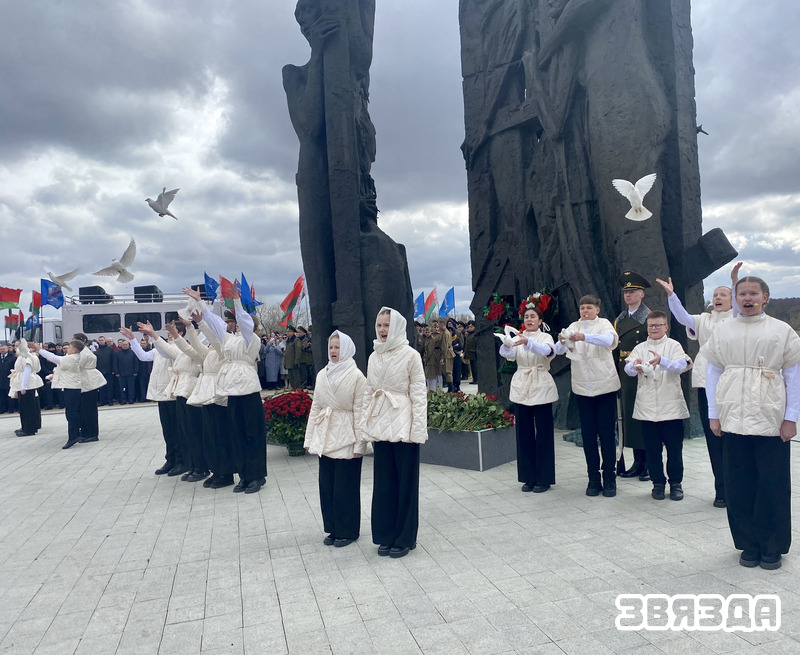
On April 11, 1945, prisoners of the Nazi concentration camp Buchenwald, led by the International Political Center, launched an armed uprising, which resulted in the capture of the camp and held it until the arrival of Allied troops. Our country remembers the terrible tragedy of that terrible war, and this Friday, thousands of Minsk residents and guests of the capital came to Trostenets memorial complex to lay flowers and pay tribute to those who became victims of fascism.
Trostenets death camp is the largest mass extermination camp in Belarus during the Nazi occupation. It is on a par with Auschwitz, Majdanek, and Treblinka. The name «Trostenets» unites several places of mass extermination: Blagovschyna tract — a place of mass executions; a camp near the village of Maly Trostenets, 10 kilometers from Minsk on Mogilev highway; Shashkovka tract — a place of mass cremation. According to official data, a total of 206.5 thousand people died in Trostenets death camp.
Trostenets death camp continued to function until the end of June 1944. People will never forget the enormous human sacrifices that the war brought. The first solemn mourning rally dedicated to the memory of the victims of fascism took place in Trostenets on September 3, 1944.
The most important thing for all Belarusians is to preserve memory
«Today we mark a truly sad date,» said Nadezhda Lazarevich, First Deputy Chairperson of Minsk City Executive Committee. «April 11 is the day when the gates of Buchenwald were opened and the world saw the horrors of war. Those people who survived carried this pain all their lives and told what it was like. Our state does a lot to preserve memory. We hold events, meet with people, support war veterans and former prisoners of concentration camps. And indeed, today here, at this memorial, we will once again bend our knee and say a big „thank you“ to those people who fought for a peaceful sky above our heads.»
Nadezhda Lazarevich emphasized that the most important thing for all Belarusians is to preserve memory: «The main thing is to remember that we are the generation of winners, that we are the people who must protect the interests of our country, protect and preserve history. And it is very important to support those people who are still alive, who have a living memory. Only in memory is there strength, only in memory is there something that will not allow us to kneel down, surrender in case of something. We will always fight, because we are the generation of winners.»
She noted the great work carried out by the Prosecutor General’s Office of the Republic of Belarus: «More and more new facts of burials are being revealed. In our country alone, there were 570 places where prisoners were directly held. They were starved and destroyed, they destroyed our spirit and our history. And, of course, now that we are revealing more and more facts, we are talking about the fact that not every fourth, but every third person in our country died, became a victim of those terrible events.»
«So that our long-suffering land never again experiences the horrors of war»
«Buchenwald, Auschwitz, Dachau, Trostenets... It seems that this black list of death camps is endless,» said Sergei Sivets, Chairperson of the Standing Commission of the Council of the Republic on Education, Science, Culture and Social Development. «This is exactly the list that is inextricably linked with tens, hundreds of thousands of human lives that became involuntary, innocent victims of war. The biography of each of them is a true example of perseverance, courage, and boundless thirst for life. And for us — those who today have the opportunity to live under a peaceful sky — this is a moral lesson. And our universal human, universal civic duty is to do everything possible and impossible so that our long-suffering land never again experiences the horrors of war. We remember, bow our knees, and will never forget this.»
Today, being at this place of tragedy, we recall the events of the Great Patriotic War, said Eduard Severin, a member of the Standing Committee on Human Rights, National Relations and Mass Media: «Unfortunately, a policy of irresponsibility is being pursued in the modern world. We see that historical memory is being erased, and our task, including that of the parliamentary body, is not only to preserve historical memory, but also to pass it on to the younger generation, to pass on responsibility for preserving historical memory. We see that in the modern political world, including in neighboring states, there is an erasure, a whitewashing of those crimes that were committed by the occupiers during the Great Patriotic War. The Russian and Belarusian sides were not officially invited to various international commemorative events for the liberation of Buchenwald. We must remember, pass it on to future generations and defend our positions at all levels: at the spiritual level, at the political level. And I emphasize once again that we are obliged to pass on historical memory and historical responsibility to the younger generations, those who will succeed us.»
«It was a very terrible time, constant cold, hunger...»
Addressing those present, former minor prisoner of Hannover concentration camp Inessa Kulaga noted that the dates of the 80th anniversary of the liberation of prisoners of fascist concentration camps and the Victory in the Great Patriotic War of 1941-1945 have become a symbol of heroism, courage and tragedy of our one Motherland — the former Soviet Union. «We, minor prisoners of fascism, having passed hundreds of thousands through the walls of 14 thousand concentration camps, ghettos, prisons, marching columns, those who saw mass executions, hangings, burnings, poisonings, bloodletting, pseudo-medical experiments, slave labor and Germanization, convey to you our memory of the atrocities of fascism and Nazism. We are giving the youth an order — do everything possible to ensure that our sad concentration camp fate never repeats itself. Raise children, study, work, protect the peaceful sky,» said Inessa Kulaga.
In a conversation with journalists, Inessa Kulaga emphasized that our youth must definitely see and hear all this: «That’s why we come to schools, gymnasiums, universities, to various patriotic events. Young people should know how bloody and terrible that war was, what atrocities the fascists and Nazis committed, how they mocked us, our people. Today, young people are growing up in a new, good country. Belarus is great, and we love it very much.»
The woman shared her personal memories of that terrible time: «I was a three-year-old child when in 1943, together with my mother and sister, I was driven to Germany. Then we were put in freight cars, we traveled for a long time... Our family ended up in Hannover concentration camp, which was completely surrounded by barbed wire. I was little, and I didn’t really understand what was happening. My father fought at the front from the very first day. And we lived in barracks, we weren’t fed, it was very scary. God forbid you, your children, to find out what war is, because constant explosions, blood are such suffering that cannot be expressed in words. It was a very terrible time, constant cold, hunger... And when we saw some pieces of bread lying around near the garbage can, we were ready to eat every crumb. If it happened that someone threw a potato or a piece of bread over the fence, the police officer would chase us away with a whip. He would trample everything under his feet so that we wouldn’t get anything. It was a very scary time, and God forbid that it happens again.»
But after several years of suffering, a bright time has come: «We still celebrate Victory Day on May 9 with such joy and happiness. We always go to holiday rallies. Time passes, everything changes, but peace must be preserved, no matter what happens!»
Daniil KHMELNITSKY
Photo by BelTA and the author