Dad was drafted into the front on June 24, 1941, when he was 29 years old. I learned this from his Red Army service book, which fortunately my mother, Maria Cherkashina — also a war participant—preserved. Later, these details were confirmed on the «Memory of the People» portal (1941–1945). There, one can also trace my father’s military path in the divisional orchestra of the 51st Guards Division, find information about his awards, wounds, hospital treatment, and discharge date. Sadly, our family only managed to reconstruct his military journey after he passed away in 1993. By 2015, on the 70th Anniversary of Victory, the full outline of his path in the Great Patriotic War emerged...

The map shows the combat path of my father as a member of the divisional orchestra of the 51st Guards Rifle Division, in honour of which one of the streets in Volgograd (Stalingrad) is named
During his lifetime, dad did not like to talk about the war. When we, his children and grandchildren, asked for details, he replied briefly, his face dimming and, as it seemed to me, hardening. Afterwards, he would go to the veranda to smoke. Over time, I understood that human nature is such that memories of painful events seem to be blocked — an instinct of self-preservation. The horrors of war paralyze memory, which explains why the faces of those who survived death and war grow silent at its mention. That’s how dad’s face became. Sometimes he opened up a little and spoke sparingly: «At war, I washed bandages, carried basins with amputated limbs, buried the dead, pulled the wounded off the battlefield, and even set up telephone communications...»
«And what about music? You were drafted as a musician, right?» I asked.
«There was music,» he said, «but first, I fed the flight crew in Valuyki. When I was drafted to the front, I didn’t mention that I could play music — there was no time for that...»
Valuyki is a special family story, more detailed than Dad’s own tales. It was told by my mother. When the war began, Dad was sent near Valuyki, a district center in Belgorod region, about 100 km from my native city Volchansk in Kharkov region, to the airfield service battalion: the 690th ASB. He was put in charge of the food warehouse. One winter, when he had to pass through Volchansk on a thirty-hundred weight lorry, he somehow managed to take his young wife and 3-year-old son with him to the battalion. But living with his family in the war zone was, of course, not allowed. My twenty-year-old mother did not return to Volchansk: she registered for work in the ASB as an accountant. Many wives with children followed their husbands to Valuyki, thinking the war would end soon. Meanwhile, my brother Yuri stayed with a local woman, where Maria Cherkashina was housed as a hired lodger.

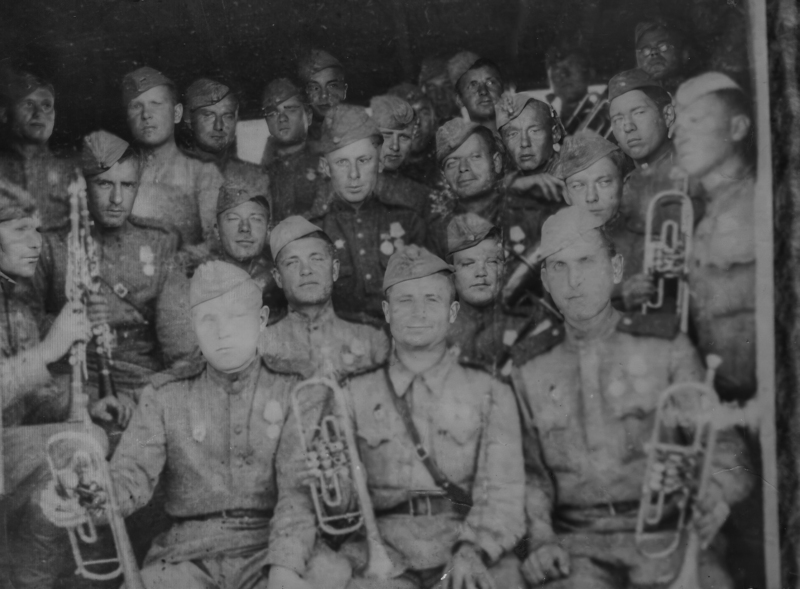
Musicians of the divisional orchestra of the 51st Guards Rifle Division. Zolochev Station in the Bogodukhovsky District of the Kharkiv Region, 1943. This photo was presented to my father by Mikhail (Moses) Cherpakov (in the photo to the left of my father), a fellow soldier from the orchestra, with whom he met twice after the war and communicated with his family. Also, in 1995, when the 50th Anniversary of Victory Day was celebrated, former front-line soldiers and veterans of the Great Patriotic War visited Belgorod, where they visited the memorial «In Honour of the Heroes of the Battle of Kursk» and paid tribute to those who died in Prokhorovka at the Museum-Reserve «Prokhorovka Field»
«It was a terrible time, cold, winter, and so many pilots died day after day...» my mother recalled.
In February 1942, dad was transferred to the 51st Guards Rifle Division and assigned to the divisional music platoon. When he served in the ASB, he told his superiors he could play wind instruments, having learned in the naval infantry, where he served for four years. His military specialty number as a wind orchestra musician was 108th — information also from his Red Army book. It also states: «Mikhail Cherkashin recognized fit for drill service and enrolled as a cadet in the Pacific Fleet Specialists School» in 1932. That year marked active creation and development of the Pacific Fleet to strengthen Soviet Far East defenses. Dad was discharged to reserve on October 1, 1936. His Red Army book also contains all his wartime awards, matching records on the website «Memory of the People».
While studying dad’s documents, I found on a musicians’ forum these lines, which confirm what dad said about his wartime duties: «The musicians’ platoon, which by old Russian tradition was part of many military units, between battles transformed under the kapellmeister’s leadership into a regimental orchestra. Musicians played military-patriotic and folk music, popular songs and marches before the troops. Often, musical groups played during offensive operations, raising soldiers’ fighting spirit, inspiring decisive attacks. During combat, musicians often served as medics, trophy and burial squads, and ammunition carriers. The combat life of ordinary soldiers in these platoons was full of danger and death, and of course, heroism».
Interestingly, while researching dad’s military path, I encountered the memoirs of front-line soldier Azamat Kaitukov, an Ossetian poet and publicist. He fought with the 158th Guards Rifle Regiment of the 51st Guards Rifle Division. Like Dad, he participated in the Battles of Stalingrad and Kursk, and Operation Bagration in Belarus. His most memorable battle was at Stalingrad. I learned this from the International United Biographical Center site. He wrote: «One evening the company commander came and said our attack would begin at dawn. „We’ll go with music, Sergeant!“ he added. At dawn, the assault rifle company took their positions. The musicians led by kapellmeister V. E. Filatov arrived. A flare lit the sky, and „The Internationale“ played. Artillery fired. „Hurrah! Hurrah!“ echoed across the trenches, and the guards division advanced...»

Excerpts from the father’s handwritten recommendations for awards from the electronic document bank «The Feat of the People in the Great 1941-1945». They can be found in their entirety on the website «Memory of the People». Interestingly, in each of the recommendations, the actions of M. S. Cherkashin are described as heroic deeds.
My father was there, too. Then, with his orchestra comrades, he helped the wounded. Thanks to invaluable internet data, I can now confirm that besides playing music, Dad carried out many other wartime duties.
To my great joy, while studying archival documents, I saw the name V. E. Filatov — the same person Kaitukov mentioned! The kapellmeister, Guards Senior Lieutenant V. E. Filatov, when recommending Mikhail Cherkashin for the Medal «For Battle Merit» on December 10, 1943, wrote:
«...Comrade Cherkashin, working in the medical-sanitary battalion as a sanitary stretcher-bearer, conscientiously carried out his duties. During the combat operation from November 8 to 13, 1943, he systematically and tirelessly evacuated wounded soldiers and officers to the sorting and operating units. Comrade Cherkashin, regardless of fatigue and rest, facilitates prompt medical aid and evacuation to the field mobile hospital...»
On December 27, the order for awarding my father was issued. Earlier, he received the Medal «For the Defense of Stalingrad», recorded in his Red Army book. It states: «For participation in the successful defeat of the Stalingrad enemy grouping, two thanks were announced by Comrade Stalin. Awarded the Medal „For the Defense of Stalingrad“ in 1943 (Presidium of the Supreme Soviet decree of December 22, 1942).»
We know the Battle of Stalingrad lasted 200 days — from July 17, 1942 to February 2, 1943. After Stalingrad, the division, as part of the 6th Guards Army, took part in the Battle of Kursk, and the liberation of Kursk, Belgorod, and Kharkov. That same year, Dad received commendation for outstanding combat actions in repelling the July German offensive near Belgorod — known historically as the Battle of Prokhorovka and the Battle of the Kursk Bulge, from July 5 to August 23, 1943.
On July 22, 1944, Dad was awarded a second Medal «For Battle Merit». Why not «For Courage», as recommended by the medical battalion commander, Guards Senior Lieutenant Ivashchenko, remains unclear. The recommendation reads:
«During the medical battalion’s deployment, Comrade Cherkashin was always in the front group, working day and night without sleep or rest to speed medical aid. From June 22, 1944, he evacuated 450 wounded to the sorting platoon. He actively participated in evacuations and is highly respected by the wounded. Comrade Cherkashin deserves the government award, the Medal „For Courage“...»

Thanks to my father’s Red Army book, military ID, and certificates for all his orders and medals, I was able to piece together the facts about my father’s war, which lasted more than 1,300 days and nights before he was seriously wounded
My father also liberated cities in Belarus. Operation Bagration, Polotsk, Vitebsk are familiar names to me. Dad was wounded twice: once on January 20, 1943 (concussion) and then seriously on January 16, 1945.
In the award sheet dated January 23, 1945, signed by Colonel Kovalenko, commander of the 49th Separate Polotsk Regiment of the Order of Alexander Nevsky and the Order of the Red Star Signal Regiment, I read about my father lines that, although formally written, somehow strike a chord deep inside. I struggle to hold back tears, painfully realizing that I never once told my dad how proud I am of him, how much I love him, and how grateful I am to him for the fact that I was born and that I live.
«Comrade Cherkashin, serving as a line supervisor (in the award citation under „position“ it is written: telephone operator on a horse cart — author’s note), in a short period of service showed himself capable of accomplishing any task assigned to him. On January 10, 1945, he performed duties as line supervisor. Without sparing his strength or life, under enemy artillery fire, he repaired over eight breaks in the communication lines within 25 minutes, thereby ensuring uninterrupted combat communication for the command. Through his practical actions, he consistently assists the company command in successfully completing assigned combat missions. While performing his duties on January 16, 1945, during an enemy air raid, Comrade Cherkashin was wounded. I petition the Military Council of the 6th Guards Army to award Comrade Cherkashin the Order of the Patriotic War, 2nd Class.»
Unfortunately, I do not know the exact circumstances under which he was awarded the combat Order of the Patriotic War, 2nd Class. Most likely, it happened in the hospital in Sverdlovsk — now Yekaterinburg — at 145 Mamina-Sibiryaka Street. There, on the building of the House of Industry, a memorial plaque made of gray marble is installed in memory of Hospital No. 414... I learned from his documents that my father was treated there for over three months.
What is remarkable is that he often recalled his injury. However, he did not speak much about himself, or about what he felt at the time, or how he was transported by sanitary train to Sverdlovsk. He spoke with pain about the fallen female signalers: «It was a direct hit on the headquarters.» He was deeply troubled when remembering that day of artillery shelling and the enemy air raid on January 16, 1945. Where did this happen? According to information I found on the internet tracing the path of the 51st Division, I can assume it was near Liepāja, when the division was moving toward Königsberg.
My father also gratefully remembered that he was saved by his comrades from the orchestra — an Armenian named Bagramyan and a Jew named Mikhail Cherpakov. «Apparently, it was fate that I should live,» he said. He was always amazed that when the guys noticed his valenki (traditional felt boots), patched with leather and sewn with a large characteristic stitch typical of Misha’s handiwork, they began clearing the debris right there. «I used to patch valenki for my comrades in the orchestra,» he told. Incidentally, he had learned this skill since he was 12, when he was an apprentice to a shoemaker. It turns out that this craft saved his life.

In a memorable photo of family heirlooms, next to a photo of my father is a photo of his wife, my mother Maria Cherkashina, a participant in the Great Patriotic War
And how fortunate it is that my father’s Red Army service book was preserved. I wonder why he never showed it to anyone... Even today, it seems to me that the familiar scent of my father, known since childhood, has not faded from its pages. I leaf through it again, along with his military ID and war participant’s certificate... Later, in 1987, he was also issued a certificate of disability related to the Great Patriotic War.
For the 80th anniversary of Victory, we gathered all the family relics related to my father’s war. Here is the medal «For the Victory over Germany in the Great Patriotic War 1941-1945.» And the second Order of the Patriotic War, 1st Class, which, like many other WWII veterans, he was awarded in 1985. And certificates for all the orders and medals... We also revived our memory of veteran Mikhail Cherkashin. And once again, we lit his fishing lantern, which we bring out three times a year: on the day of my father’s remembrance, January 16; on his birthday, October 29; and on Victory Day. My father revered this holiday. Every year during his life, after the festive parade, the family would gather in Volchansk. If the weather was warm, it was in the blooming apple orchard. This picture from my childhood and school youth often comes to mind.
A hot, blooming May. After playing in the orchestra on the central city square, where the festive rally was held, my father cooked on the fire. In a large pot, field porridge was simmering, and everyone was cheerful. «If only I could find Bagramyan, he would make us some shashlik here,» my father laughed. «But the thin gruel will have chicken.» He didn’t find Bagramyan. But he did meet with Mikhail Cherpakov — both in Volchansk, where Moisey Zalmonovich came to visit with his wife, and in Riga, where my father and mother made a return visit. My mother laughs, telling my sister that when Misha Cherpakov came on Victory Day, he always ordered a salad with green onions and eggs, and okroshka. Auntie chops green onions and dill, boiled eggs are peeled and crumbled, my cousin and I cut radishes. And the greens — fresh from the garden. In southeastern Ukraine, they were already ready by May 9.
... Here among us are my own brother, the trumpeter Yuri, and our cousin, the family favorite, pilot-navigator Oleg Lugovsky with his wife Maria, whose father died in ’44 and was buried somewhere in Estonia. May he rest in peace, as do my parents...
Bright memory and eternal glory to all who gave us peace.
Valentina Zhdanovich