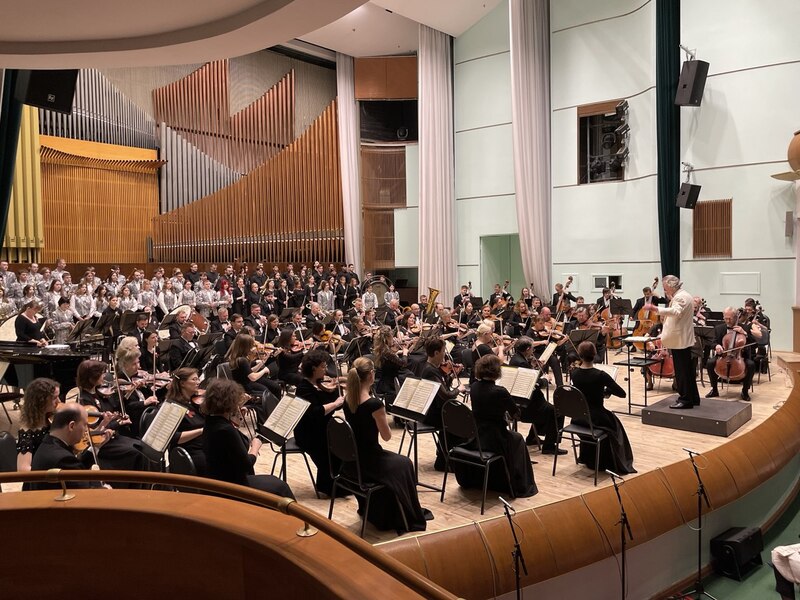
The initiative for such a large-scale event — uniting seasoned symphonic professionals with talented young musicians from these educational institutions — came «from us», said Alexander Anisimov, People’s Artist of Belarus, State Prize laureate, chief conductor and artistic director of the State Academic Symphony Orchestra.
We met with Maestro Anisimov a few days before the concert, and he spoke about the ensembles preparing to take part in the event commemorating 80 years since the Victory in the Great Patriotic War, as well as the musical pieces that would be performed. One of the participating orchestras was the student ensemble from the Academy of Music, which had previously collaborated with the State Symphony Orchestra. According to Alexander Mikhailovich, their most recent joint success was a performance of Berlioz’s «Symphonie Fantastique». This orchestra is led by Alexey Andreev. «The second ensemble,» he continued, «is a very charming concert group from the Minsk State Music College named after M. I. Glinka. On May 6, they had their own major concert consisting of two parts. Their wind orchestra is directed by a talented musician, an excellent saxophonist, and head of the department at the college — Pavel Kazak.» The third ensemble is the «Svetoch» Concert Orchestra of Wind and Percussion Instruments from the Belarusian State University of Culture and Arts, led by associate professor Viktor Volotkovich. This orchestra remains an active presence in the country’s musical life and also took part in the festive program, conducted by Honored Artist of the Republic of Belarus Yevgeny Dovzhik.
We came to the concert already familiar with the program and, once again, with a deep awareness of the significance of this date, celebrated across the entire country. It was the Great Victory that brought peace to our land — and to many other nations once seized by fascism. By celebrating Victory Day, we pay tribute and express our deep respect to all those who brought that Victory closer — and through it, we also honor the gift of peaceful life. Remembering the brutal war, which claimed countless lives and caused immense destruction, we strive for peace and are determined to protect and preserve it with all our strength. That is why the activists of the Belarusian Peace Foundation — among them Alexander Anisimov, who also serves on its board — continue to call for peace, including through the powerful language of music.
In his address at the military parade in Minsk on May 9, 2025, dedicated to the 80th Anniversary of the Soviet people’s Victory in the Great Patriotic War, President Aleksandr Lukashenko stated: «Belarus’s peaceful rhetoric should not be misinterpreted. Yes, we call for peace. Yes, we wholeheartedly want to end all wars and conflicts on this planet.»
These calls for peace are echoed in music, in songs, in theatrical performances, and in cinema.
The «Festive Parade of Orchestras» began with a powerful moment of collective performance — all the participating orchestras joined the symphony orchestra on stage. Nearly 250 musicians filled the hall as they performed Dmitri Shostakovich’s famous «Festive Overture». Those familiar with the score would have anticipated the dramatic finale, where an additional wind orchestra enters — and indeed, the thunderous music swelled through the hall, creating the atmosphere of a true celebration.
After the joint performance, each orchestra presented its own program. The repertoire included works written specifically for wind instruments — complex and demanding pieces. As Alexander Anisimov put it, some of them were downright virtuosic: «Even if they carry a touch of jazziness — a kind of lightness — they still remain firmly within the realm of classical music.»
Each orchestra paid tribute to the central theme to which the «Parade...» was dedicated. However, the main segment of the program, of course, was carried by the symphony orchestra, which performed Belarusian compositions, wartime music, and classical pieces. Joining the orchestra were vocal soloists and masters of the stage — the accomplished singers Irina Krikunova and Igor Zadorozhny.
The symphony orchestra began with Mikhail Glinka’s famous overture to the opera «Ruslan and Lyudmila». Then the musicians played music by Kirill Molchanov from the opera «The Dawns Here Are Quiet»: a touching waltz called Pre-War Life. This was followed by Zhenya Komelkova’s song «Wait for Me, and I’ll Come Back», performed by Irina Krikunova. Igor Zadorozhny sang Igor Lukchenko’s famous songs «Dark Night» and «May Waltz» with great feeling. The emotional impact of the familiar melodies on the audience was strong. Older viewers wiped away tears, and the younger audience was not left unmoved either. It was necessary to see the serious faces of young people captivated by the soulful music.
The concert concluded on a symbolic note with the performance of Pyotr Tchaikovsky’s grand overture «The Year 1812» — the composer’s famed orchestral piece written to commemorate Russia’s victory in the Patriotic War of 1812. In the triumphant finale, all the wind orchestras joined in with a resounding force as the «bells and cannons» rang out. As we know, Tchaikovsky vividly portrayed the triumph of the Russian army in this work, using the dramatic effect of pealing bells and cannon fire. And at that moment, all four orchestras were on stage! Some of the musicians from «Svetoch» even positioned themselves in the aisles among the audience, playing from within the hall. It was a breathtaking sight. The music was so powerful, so overwhelming, that it felt as though everyone present had become one — united in the spirit of celebration, honoring the great Victory of 1945.
As the music swelled and unfolded, the audience was overcome with growing awe and elation. It felt as if one were soaring along with the sound, carried by a wave of emotional uplift — a moment when it truly seemed possible to become better, purer, kinder. And in that moment, it felt certain that wars would end — completely and forever — across the entire world.
The program turned out to be vibrant, emotional, and truly festive — and how could it be otherwise? After all, it was conceived by Alexander Anisimov, and we know well how deeply he immerses himself in every piece of music, both as a conductor and as one of Belarus’s most renowned and sought-after musicians. His talent has earned recognition from audiences across the globe — from Argentina to Australia, Houston to San Francisco, Venice to Berlin, from the Grand Opera and Opera Bastille in Paris to the Gran Teatre del Liceu in Barcelona and other prestigious stages around the world.
«I hope that the powerful message we envisioned together with the Peace Foundation has truly come to life,» says the maestro. «The audience came from all across Belarus. The Philharmonic Hall seats just over 600 people — and it was packed. I even thought our program would have sounded wonderful in a larger venue. But on the other hand, Victory Day is a celebration with tears in our eyes, so perhaps it’s for the best that it took place in our home hall, our beloved stage. I felt as though we were one big family, gathered to honor the memory of those who are gone and to celebrate the Great Victory together. I’m glad that the program generated such excitement.» But of course, we know well that whenever Anisimov’s name appears on a concert or premiere poster, it always means a full house and electrified anticipation.
Incidentally, the theme of war plays a very personal role in the maestro’s life as well. He cherishes a photograph of his mother in military uniform — a photo he keeps with reverence. According to him, she ended the war in Belarus at the headquarters of Marshal Konstantin Rokossovsky. «Maybe that’s why it was no accident that I found myself in Belarus,» he reflects. «I’ve been here for 40 years, and for nearly 25 of those, I’ve led the Philharmonic’s orchestra. Before that, I was chief conductor of our Bolshoi Opera and Ballet Theatre. Belarus is my second homeland — and in my heart, it holds equal place with Moscow, where I was born.»
Alexander Anisimov also added: «We not only understand the political, military, and human significance of Victory, but we also realize that thanks to it, we preserved our culture, our country’s spiritual wealth — and that includes our musical heritage. Minsk is a musical center of Europe. And today we celebrate the Victory of our fathers, mothers, grandfathers, and great-grandfathers. We must cherish it and never forget.»
By Valentina Zhdanovich
Photos by Ivan Zhdanovich