Once gold was sought in the subsoil of the earth, then oil. Today both are still in price, but rare-earth metals have become more expensive than gold and even «black gold» with the development of technologies. The Belarusian geologists have been instructed by the head of state to search for them. Let’s find out why they are so valuable, whether they exist in the Belarusian soil, and what else can be found in our subsoil.
More than six dozen rare earth elements (i.e. lanthanides) are known, and in the modern world they are widely used in the most high-tech industries — from space, drone construction, nuclear power engineering to electronic devices and production of the latest materials. There are rare-earth elements in Belarus. They were explored back in Soviet times. But they were not mined before: the explosive interest to them in the world has emerged only in recent decades. And although the extraction of these metals is associated with certain difficulties (first of all, with the great depth of their occurrence), it is among the priorities for the coming years. What other tasks geologists set themselves today, says Vasily Kolb, Deputy General Director for Geology of the State Enterprise «Research and Production Center for Geology»:
— The plan-schedule of works on the study of subsoil of Belarus for 2026-30 is focused on solving important tasks for the country’s economy. This is the search for new areas of hydrocarbon occurrence in order to increase oil resources and reserves, to analyze and interpret hydrocarbon materials. Emphasis is placed on the regional study of subsoil, conducting medium-scale geological survey works to prepare for the publication of the State Geological Map of Belarus. The plan envisages updating the geological and tectonic map of the country, additional study of the areas promising for the detection of rare-earth elements and metals. Undoubtedly, an urgent topic is to build up raw material bases for enterprises. As well as increasing the level of digitalization of the geological industry.
«Oil»
— The territory of the Pripyat Trough remains the main territory for hydrocarbon production, prospecting and ensuring the growth of oil reserves: first of all, the Gomel Region and the southern part of the Mogilev Region, — says Vasily Yurievich. — At the same time, in the fall of 2024, the State Enterprise «RPC for Geology» started drilling a parametric well in the Orsha Depression of the Vitebsk Region. The purpose is to clarify the structure of the geologically poorly studied territory and the possibility of determining the prerequisites for hydrocarbon discovery. If the results are positive, the study of the Orsha Depression will continue in the new five-year period.
Not so long ago, an oil deposit was found in the Petrikov District almost by accident. It happens in geology, says the interlocutor: the search for some fossils leads to the discovery of other deposits.
— In 2019, while drilling a well for the injection of excess brine from the processing of potassium salts by Belaruskali JSC, an inflow of oil was noted. Not to say that this case is unique, but when planning the work, there were no unambiguous assumptions of detecting oil in the interval and sediments for which the well was drilled, — the geologist explains.
Well depths for hydrocarbons can vary in intervals from 2.5 to 5 kilometers, he notes. That is why there are risks of not confirming hydrocarbons. The peculiarities of geological conditions that are characteristic of such depths can play a role: fault zones that block the possibility of hydrocarbon accumulation.
— Risks arise even though such wells are designed taking into account geological data and data on already existing oil-prospective wells. That is why only through drilling wells in a certain area of the subsoil, and preferably several wells, extracting core material from them and its scientific analysis, it is possible to talk about the prospectivity or non-prospectivity of hydrocarbons in a particular area.
More expensive than gold
Returning to the topic of rare-earth metals, the Deputy Director General of «RPC for Geology» emphasized:
— To solve the tasks set by the head of state on March 4, 2025, the Ministry of Natural Resources and specialists of our enterprise are preparing proposals for conducting searches for rare-earth elements and metals in the near future.
So far in these searches it is planned to apply classical geophysical research with drilling and laboratory studies to determine the prospectivity of a particular territory, said the specialist. But new technologies, of course, expand the possibilities of geologists.
— An example is horizontal drilling of wells using hydraulic fracturing. This allows to maximize the use of the well’s capabilities to get a flow of so-called hard-to-recover oil. Oil thinners are also used to enhance oil recovery.
«Have to dig»
Which region of our country is the most interesting in terms of mineral resources? Each region is rich in its own way, says the interlocutor.
— Undoubtedly, Gomel Region is the most productive for geologists: almost all hydrocarbon reserves are concentrated on its territory. Potassium and rock salt, building and facing stone, sands used for glass production are also explored and extracted. In the Brest Region there are also explored reserves of building stone, kaolin, basalt, refractory clays. The western and eastern parts of the country (Grodno and Mogilev Regions) are rich in chalk and clays used for cement production, Vitebsk Region — in dolomite.
— In general, can the Belarusian subsoil be assessed as «rich»?
— Not as rich as, for example, the territory of Russia. But we are self-sufficient in many minerals. As I have already mentioned, each region is rich in certain types of minerals — sands, clays, chalk, dolomite, basalt, tripoli, building and facing stone, potash and rock salt, oil, iron ore. And we are constantly increasing the level of geological study of the country’s territory.
Thus, today geologists are concentrating on the previously poorly studied territories of Vitebsk, Mogilev and Gomel Regions. The works are aimed at updating geological maps, revealing the conditions of mineral resources occurrence taking into account new scientific approaches. Work is underway on refractory clays in the Brest Region, sands for glass production in the Gomel Region, and chalk in the Grodno Region.
Looking ahead
Potassium salts, the «main» Belarusian mineral, have been identified today within the Minsk Region — these are the Soligorsk and Lyuban Districts, as well as the Petrikov District in the Gomel Region.
— Potassium salt reserves make it possible to ensure the work of enterprises for hundreds of years without new growths, — says the geologist. — In the near future, taking into account the existing raw material base, it is not envisaged to search for new deposits of potassium salts.
But basalt is the most economically justified from the point of view of development prospects today, says Vasily Yurievich:
— This new for the republic type of mineral was discovered in the Pinsk District in the last five-year period. Its preliminary exploration was carried out first, and in 2023 — its detailed exploration. In terms of quality, this domestic raw material is similar to basalt imported from Ukraine until 2022. The explored reserves of Belarusian basalt allow to create a mining and processing plant on the basis of the deposit and 3 more production facilities to manufacture products based on this mineral, and fully provide the domestic market of the country, as well as exports, both in raw materials and products.
And how realistic (purely theoretically) is it to find a deposit of precious stones in our country? In the core material extracted from the rocks of the crystalline basement, their single grains are noted, but we cannot talk about industrial reserves yet, the expert explains.
— As for amber, its deposit is in the Zhabinka District. Experimental works on its extraction have been carried out, but their economic efficiency has not yielded positive results.
However, geology is a prospective work, and it is difficult to predict what the industry will demand, say, a quarter of a century later.
— If we talk about providing enterprises with raw material resources, it is necessary to create reserve raw material bases of a particular mineral: this is the guarantee of stable development of the enterprise and the region as a whole. Regional works or geological mapping is the acquisition of new information about the structure of our subsoil, the prospect of identifying new types and deposits of minerals. A developed mineral resource base is the basis of security of any state, — summarized Vasily Kolb. — What is economically inefficient today, in 10-15 years can give quite a different effect.
Aleksandra Antselevich
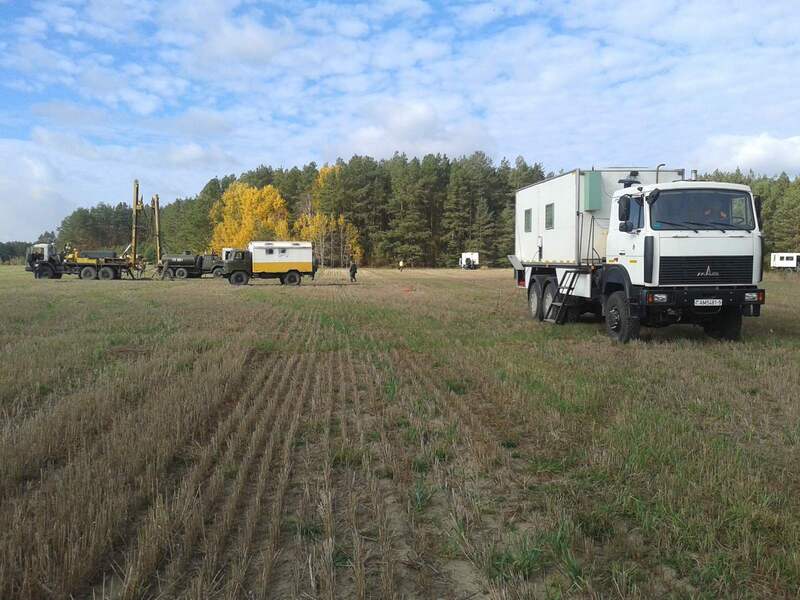
Photo from the archive of «RPC for Geology»
833
What the Belarusian subsoil is rich in
12.05.2025 | 18:01
From salt to rare earth metals
Views: 833